 Photo: Adobe Stock; Kara McGrathSave this storySave this story
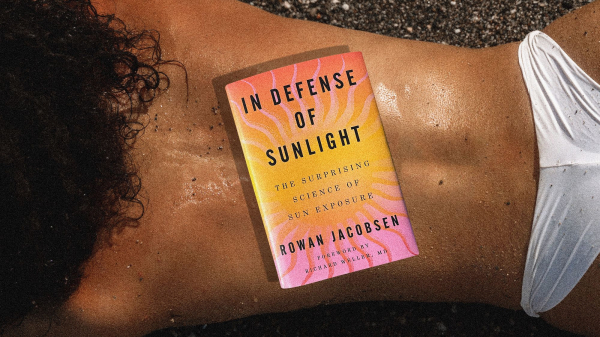
“Get sun. Not too much. Go outside.” The Pollanian thesis of Rowan Jacobsen’s new book, In Defense of Sunlight, sounds reasonable enough. Parents everywhere have been peeling their children—and frankly themselves—away from screens and sending them out into the sun since those screens have been invented. “Touching grass” has become an aspirational activity.
“I wrote the book because I thought we were getting to a point where our avoidance of the sun had gone too far,” Jacobsen told me recently, while we sat on a bench in Cobble Hill Park in Brooklyn, a Callery pear tree providing shade on one of the first warm, sunny days this spring. (I was testing the new SPF 30 from Peach & Lily; Jacobsen was sunscreen-free.) “People were being told to apply sunscreen every two hours in the middle of winter when they were working indoors.”
I first learned of Jacobsen’s work in 2024, when he wrote an article for The Atlantic called “Against Sunscreen Absolutism.” The story was in praise of Australia’s then-recently-revised sun safety guidelines, which split the population into three groups and offered different SPF guidelines for each: People with pale skin and/or additional risk factors for skin cancer should keep wearing sunscreen every day, those with “olive or pale-brown skin” should only use it if the UV Index was above 3, and those with the deepest skin tones only need sunscreen for long beach days and other excursions that would lead to spending hours in the bright sunlight. “Yes, UV rays cause skin cancer, but for some, too much shade can be just as harmful as too much sun,” Jacobsen wrote at the time.
This story went viral in the very specific group chats I’m privy to as a beauty editor. Dermatologists felt this guy was trying to undo all the hard work they’d put into convincing people to wear sunscreen as a preventative health measure. The American Academy of Dermatologists (AAD) even released a formal statement saying Jacobsen’s article “contains misleading information that may discourage the public from using sun protection, thereby increasing their risk of skin cancer.” I also issued a formal response in this very publication, acknowledging that sunscreen evangelists can be a bit dramatic (no, I don’t actually think I need to apply SPF every two hours in the middle of January when I have no plans to leave my house), but also that being extreme can seem necessary to dermatologists who struggle to get their patients to use sunscreen at all.
Two years later, the general public only seems less convinced that sunscreen is a useful health care tool and more certain that they should be availing themselves of regular UV exposure. Tanning is on the rise, especially among Gens Z and Alpha although our current Boomer health secretary is also a fan. People on TikTok are sharing their “get ready to lay out with me” routines, and many more are tracking the UV Index to make sure they’re outside at peak hours for skin-darkening sun damage. Invasive melanoma rates have generally increased since the 1970s, and a recent study by the American Academy of Dermatology found that more than 20% of Gen Z respondents prioritized getting a tan over protecting their skin. Folks of a certain mindset are claiming that, actually, the sun is good and it’s sunscreen and sunglasses that are making you sick. The Centers for Disease Control and Prevention (CDC) has reported that only 12% of men and 30% of women always use sunscreen if they’re going to be outside for more than an hour on a sunny day. In sun-adjacent news, the FDA recently blocked a bill that would have banned the use of tanning beds for anyone under 18. It would seem that there are plenty of folks—some of them with much public-health power—embracing UV rays in full force.
So do we really need to be defending the sun in 2026? Jacobsen is quick to clarify that he’s not in the anti-sunscreen, get-ready-to-lay-out-with-him camp, but also argues there’s no need to panic about our culture’s current wave of UV enthusiasm. His book is a tight 199 pages (268 if you count the glossary, resources, notes, and index at the end) and cites nearly as many studies—many published in peer-reviewed journals like the Journal of the American Medical Association, The Lancet, and even the Journal of the American Academy of Dermatology—that point toward prolonged sun avoidance being quite dangerous.
“Sun deprivation was linked to heart attack, stroke, diabetes, dementia, depression, Parkinson’s, myopia, respiratory infections, certain cancers, and autoimmune conditions such as multiple sclerosis and inflammatory bowel disease,” he writes in the introduction. “That evidence had been showing up in various observational studies for decades, but it had been growing stronger as the tools got better.” At one point, he cites a study published in the Journal of Internal Medicine that found nonsmokers who avoided the sun had about the same life expectancy as smokers who embraced the sun. “Avoidance of sun exposure seems to be a risk factor of magnitude similar to smoking in terms of life expectancy,” the authors concluded.
“Sun deprivation” isn't an officially defined term; most of the studies Jacobsen cites look at self-reported time spent in (or avoiding) the sun alongside vitamin D levels and health outcomes. Jacobsen tells me his "not official nor a prescription, just one informed guy’s back-of-the-envelope rubric" is that you're probably “deprived” if you're not getting enough sun to maintain a vitamin D level of 20 ng/ml or above (without supplementation). The amount of time you'd need to spend outside to reach those levels will depend on the weather, season, your skin tone, and location. “But as a general rule, it’s never about getting lots of sunlight, it’s about making sure you get more than none,” he says.
On the flip side, spending some time in the sun is linked with, well, less of all the risks mentioned above: less depression, lower blood pressure, a lower risk of diabetes, enhanced wound healing, less heart disease, better mental health, less fatigue, fewer autoimmune disorders…essentially, being outside seems to be quite good for you. It used to be widely accepted that this was because UV rays help your body produce vitamin D. But, Jacobsen and many scientists now argue, if it was just a vitamin D thing, then you should be able to pop a pill and stay inside forever. Instead, more recent studies have found that, while vitamin D supplements do, indeed, raise vitamin D levels, those artificially-achieved higher levels don’t necessarily correlate with better health outcomes.
“They basically set the recommendations for the palest people, assuming everyone else could do that too and it wouldn’t cause any harm.”
It seems that the sun provides some special sauce when it comes to human health, though the exact mechanism behind its benefits is still being studied. The nitric oxide we produce when UV rays hit our skin probably plays a role; the low levels of inflammation created by the sun may as well. To be clear, there is still zero science that recommends excessive amounts of unprotected sun exposure; 15 minutes a day seems to be plenty. Jacobsen compares it to allergies: Children who are introduced to small amounts of peanuts or exposed to microbes on farms are less likely to develop allergies and asthma as they grow up.
Jacobsen believes the messaging about sun protection has been so loud because the organizations behind it—like the Skin Cancer Foundation and the AAD—are well-funded enough to be very effective at achieving their goals, which is to spread the word about the risk of skin cancer. “There are no bad guys in this story,” he says. “Everybody is doing their job. But in the sciences now, your job tends to be very specialized.” Dermatologists care about skin cancer above all else. Cardiologists care about heart disease above all else. Neither doctor is more or less right in their convictions, but, when assessing risk, a human being must take into account all of the things that might kill them.
For its part, the AAD is still not on board with Jacobsen’s point of view. In a statement sent to Allure, the organization’s current president, Murad Alam, MD, said, “In Defense of Sunlight: The Surprising Science of Sun Exposure, seeks to undermine long established public health guidance aimed at preventing skin cancer, the most common cancer in the U.S.” Dr. Alam feels that the research Jacobsen cites is “weak evidence” that sunlight may provide health benefits. “Many of the claims in this book are inadequately supported by low-level evidence, a single supportive paper, or the personal opinions of one doctor,” he wrote. “On the other hand, the science linking unprotected sun exposure to skin cancers, including melanoma, is longstanding and well-established.”
“Many of the claims in this book are inadequately supported by low-level evidence… on the other hand, the science linking unprotected sun exposure to skin cancers, including melanoma, is longstanding and well-established.”
Jacobsen is a science journalist. He does not have a medical degree in any specialty. He also doesn’t dispute the evidence that unprotected sun exposure leads to skin cancer and recommends wearing sunscreen throughout the book, as well as during our interview. But after nine years of research, reviewing hundreds of studies, and interviewing dozens of doctors and scientists, he’s concluded that a risk of skin cancer should not be anyone’s primary concern within the grand scheme of health conditions. “Globally, skin cancer doesn’t even make the list of 40 deadliest killers,” he writes in this new book, noting the gulf between its 120,000 annual deaths compared to the 20 million from cardiovascular disease and 10 million from other forms of cancer. Another anecdote that stuck with me: "When [dermatologist Richard Weller, MD] and his graduate student ran the numbers [from the UK Biobank dataset], they found that in the 15 years of tracking, a total of 40 people had died from skin cancer attributable to too much UV light, while 2,982 people had died from diseases attributable to a deficiency of sunlight." Of course, while skin cancer is far from the deadliest of cancers, it is—as the AAD points out—the most common in the U.S. And treating it often involves painful procedures and surgeries that can be disfiguring.
This relax-about-skin-cancer approach, Jacobsen believes, particularly applies for people with darker skin tones, who have been beholden to medical guidelines developed primarily for white folks. “They basically set the recommendations for the palest people, assuming that everyone else could just do that too and it wouldn’t cause any harm,” he told me. “But it looks like it probably does.” Per his reporting, the diseases that are correlated with low sun exposure—like cardiovascular disease and diabetes—disproportionately affect Black people, while skin cancer remains relatively rare for the demographic. Jacobsen calls for an end to blanket guidelines and advocates for individualized sun safety routines recommended by an individual’s doctor that take skin tone and other risk factors into account.
This is a logical argument, but unfortunately we are not living in logical times. While the book may be about sunlight on the surface, all I could think about while reading it was the difficulty of using nuance in public health messaging. Take sunscreen, one example discussed extensively in the book and across social media. Misinformation on the topic has gotten extremely widespread. This year, the AAD found that “more than 16 million adults report reducing or stopping sunscreen use because of online claims.” Last month, even a national news organization ran with this headline: Buyer beware of sunscreens: New report finds few meet safety standards. The story cited only the EWG, an activist group many doctors and scientists see as a biased source.
Jacobsen, for his part, is not on the side of the anti-SPF influencers. “Everyone wants to make [my book] a battle against sunscreen,” Jacobsen says. “Sunscreen is better than burning,” he continues. “Every expert I’ve talked to agrees that burning is bad. If sunscreen is going to help you avoid burning, great.” His own sun-protection routine seems to align with the well-known best practices Dr. Alam reiterated in the AAD’s statement to Allure: “While incidental and occasional sun exposure is common and unavoidable, given the known risks of sun exposure and skin cancer, it is important that, when possible, we protect ourselves in the sun by seeking shade, wearing protective clothing, and applying a broad-spectrum, water-resistant sunscreen with an SPF 30 or higher to all skin not covered by clothing.”
Jacobsen says he wears sunscreen anytime he’s worried he might burn, but prefers to wear long sleeve shirts and broad brim hats to prevent overexposure. Plus, “I don’t bask in the sun for hours. I get a lot of incidental sun exposure going about my day, or swimming, but I get bored just lying on the beach for too long.” He’s not loyal to any particular SPF brand; he just looks for sunscreens with broad-spectrum coverage, which, as far as chemical filters go, typically means avobenzone in the U.S. (though we finally—after 27 years—got a new option this month). Jacobsen acknowledges the concerns about ingredients in sunscreen but ultimately believes the risk is low: “I think of it as a great tool to help people spend more time outside,” he says. “But while I think the risks from chemical sunscreens are minimal, the risks from hats and shirts are lower still,” he says of his own protection habits.
This is a logical argument, but unfortunately we are not living in logical times.
The history of sunscreen is certainly riddled with its own dark spots. One of the earliest products was Ambre Solaire, introduced in 1935 by the founder of L’Oréal. The first version was a tanning oil with benzyl salicylate that promised a safer tan but ultimately had extremely low SPF (a term that wasn’t introduced until 1974). As Jacobsen wrote in In Defense of Sunlight, the original chemical filters in commercially available sunscreens, like the aforementioned benzyl salicylate, only blocked out UVB rays, meaning they largely prevented burns but—because UVA rays were still getting through—people were still getting skin cancer. Scientists recognized this correlation and started to sound the alarm: In 1990, the New York Times published a story titled “Theory Hints Sunscreens Raise Melanoma Risks,” which outlined the theory of two researchers who believed that the UVB-blocking sunscreens gave people a false sense of security. Those people, they speculated, spent more time in the sun, therefore soaking their skin in more melanoma-causing UVA rays.
Despite the fact that broad-spectrum sunscreens, which block out both UVA and UVB, have been easy to buy for over 40 years, perhaps this NYT headline and others like it are where our nuanced understanding of sun exposure went out the window. (Much like what “Hormone Replacement Therapy Linked to Breast Cancer and Heart Risks” did in 2002 for menopausal women’s access to the medications that were protecting their hearts, bones, and minds. Dozens of studies since have shown that the benefits outweigh the risks.)
Even the studies that call insufficient sun exposure a public health issue recommend a daily maximum of 30 unprotected minutes.
People still claim that sunscreen causes cancer, though now the accusation is typically linked to concerns about the ingredients. The whole benzene contamination situation in 2021 did not help sunscreen’s reputation. The dose makes the poison, and while Jacobsen worries that those “reapply-every-two-hours-even-inside-even-in-winter” recommendations could be increasing the sunscreen dose to a concerning amount, again, the research he did for this book leads him to believe the ingredient risk is still quite low and getting lower with each new advancement in filter technology.
“I definitely wouldn’t want people to have the takeaway message [of the book] to be, ‘I can do anything I want!’” with regards to sun exposure, Jacobsen says. He wishes more countries would move toward the newer Australian guidelines and its three “levels” of sunscreen recommendations. Even the studies that call insufficient sun exposure a public health issue recommend a daily maximum of 30 unprotected minutes in the sun.
But how do we get to a point where the general public is capable of understanding nuance in health recommendations? Well, for one, our health care system could, to put it mildly, use some work. If everyone actually had access to a medical team who could help them navigate all of this complicated science to craft a plan that works best for them, we wouldn’t need to rely on influencers with vaguely professional sounding backgrounds sharing information (misinformation?) for free.
Since that doesn’t seem in the cards anytime soon, I asked Jacobsen if the experts he spoke with for the book had any ideas. “Not really. That messaging is not their specialty or their strength,” he says. “They don’t even want to think about it really. They just want to do their research and talk to individual patients.” I asked Julian Sass, a cosmetic chemist with a focus on sunscreen and a background in public health education, if he could think of any effective public health messaging that had a more nuanced take than the “all or nothing” language we see around things like sun exposure, smoking, and drinking while pregnant. “Not in an American context, no,” he says. “There are some things that have worked with at-risk populations utilizing screening/medications against diseases that disproportionately affect their communities, but I can't immediately think of any ‘nuanced’ public health messaging that has been effective.” (Some examples he gives are men who have sex with men utilizing PrEP, breast cancer screenings for older women, and prostate cancer screenings for older men.) He also pointed back to the CDC data about how few people are wearing sunscreen every day anyway. “There aren't enough people wearing it in the first place to necessitate any kind of nuance,” Sass says.
Public health guidelines are about sharing the best advice science is able to offer to the general population—knowing full well that the rules don’t apply to everyone. We tell people to never smoke, but know a couple cigarettes a year is not going to kill you. We tell pregnant people to avoid even a drop of alcohol at all costs, although there are parents who have a healthy baby despite drinking for the first five months of pregnancy when they didn’t realize they were pregnant. But the most extreme recommendation is considered the best one in all of these cases because you give someone a cigarette… they might come to light up a pack a day with it. A pregnant person’s celebratory champagne could slide into a nightly gimlet. And give people an inch of wiggle room on sunscreen reapplication? Well, they could run a skin-exposed mile in the mid-day sun with it
While influencers who say “do your own research” often mean “watch my videos and buy my products,” it is good advice as long as your research involves examining multiple studies done by experts in the relevant field. With In Defense of Sunlight, Jacobsen has compiled compelling arguments for getting outside. Like, did you know research shows that modern hunter-gatherer tribes who spend most of the day outside seem to physically require fewer hours of sleep than us office workers? He has also acknowledged the risks of raw dogging UV rays—namely skin cancer and photoaging. At the very least, the book will convince you to start your mornings with a stroll instead of a doom-scroll, which I think every doctor—even dermatologists—would co-sign. Just make sure to put on your sunscreen first.